Reading Tooth Contact of Crown Wheel and Pinion

Gear Contact Test

Prepare crownwheel for examining tooth contact. After setting the correct backlash, the crownwheel and pinion tooth alignment should be checked for optimum contact. This may be achieved by applying a marking cream such as Prussian blue, red lead, chrome yellow, red or yellow ochre etc. to three evenly spaced groups of about six teeth round the crownwheel on both drive coast sides of the teeth profiles. Apply a load to the meshing gears by holding the crownwheel and allowing it to slip round while the pinion is turned a few revolutions in both directions to secure a good impression around the crownwheel. Examine the tooth contact pattern and compare it to the recommended impression.
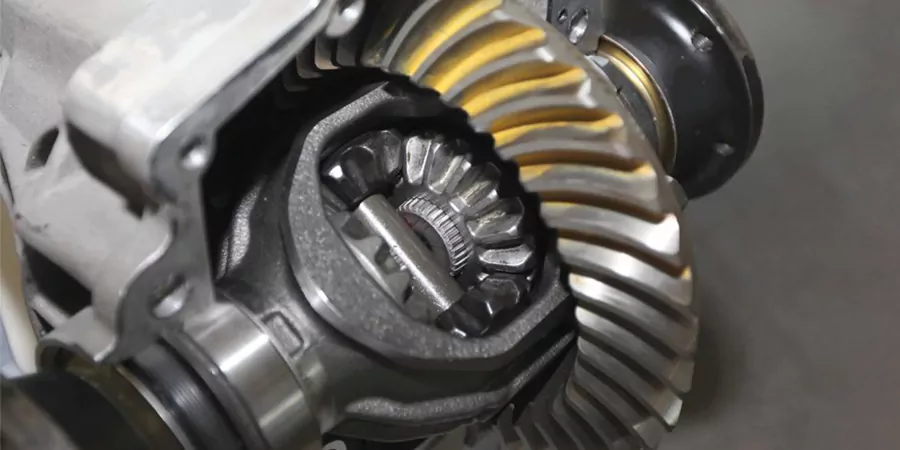
ring gear and pinion gear

Gear Structure

Understanding tooth contact marks (Fig. (a-f)) If the crown wheel to pinion tooth contact pattern is incorrect, there are two adjustments that can be made to change the position of tooth contact. These adjustments are of backlash and pinion depth.

Gear bite and solution

Gear Contact Patterns

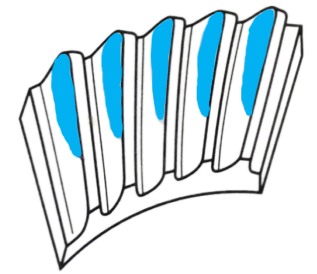
The adjustment of backlash moves the contact patch lengthwise back and forth between the toe heel of the tooth. Moving the crownwheel nearer the pinion decreases the backlash, causing the contact patch to shift towards the toe portion of the tooth. Increasing backlash requires the crownwheel to be moved sideways and away from the pinion. This moves the contact patch nearer the heel portion of the tooth.
When adjusting pinion depth, the contact patch moves up and down the face-flank profile of the tooth. With insufficient pinion depth (pinion too far out from crownwheel) the contact patch will be concentrated at the top (face zone) of the tooth. Conversely, too much pinion depth (pinion too near crownwheel) will move the contact patch to the lower root (flank zone) of the tooth.
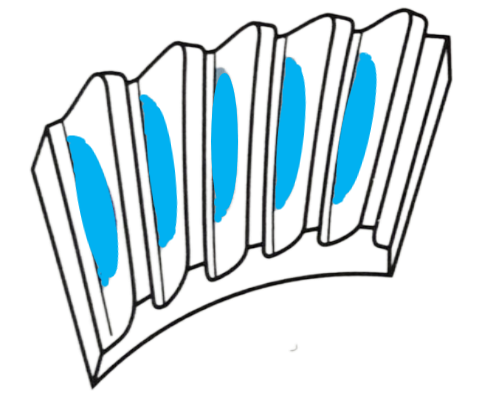
Ideal tooth contact (Fig. (b)) The area of tooth contact should be evenly distributed over the working depth of the tooth profile and should be nearer to the toe than the heel of the crownwheel tooth. The setting of the tooth contact is initially slightly away from the heel and nearer the root to compensate for any deflection of the bearings,crownwheel, pinion and final drive housing under operating load conditions, so that the pressure contact area will tend to spread towards the heel towards a more central position.

Optimal Contact: pattern is concentrated in the center of the drive gear tooth.

HIGH CONTACT
Heavy face (high) tooth contact (Fig.(c)) Tooth contact area is above the centre line and on the face of the tooth profile due to the pinion being too far away from the crownwheel (insufficient pinion depth). To rectify this condition, move the pinion deeper into mesh by using a thicker pinion head washer to lower the contact area and reset the backlash.

LOW CONTACT

Heavy flank (low) tooth contact (Fig. (d)) Tooth contact area is below the centre line and on the flank of the tooth profile due to the pinion being too far in mesh with the crownwheel (too much pinion depth). To rectify this condition, move the pinion away from the crownwheel using a thinner washer between the pinion head and inner bearing cone to raise the contact area and then reset the backlash.

TOE CONTACT

Heavy toe contact (Fig. (e)) Tooth contact area is concentrated at the small end of the tooth (near the toe). To rectify this misalignment, increase backlash by moving the crownwheel and differential assembly away from the pinion, by transferring shims from the crownwheel side of the differential assembly to the opposite side, or slacken the adjusting nut on the crownwheel side of the differential and screw in the nut on the opposite side an equal amount. If the backlash is increased above the maximum specified, use a thicker washer (shim) behind the pinion head in order to keep the backlash within the correct limits.

HEEL CONTACT

Heavy heel contact (Fig. (f)) Tooth contact area is concentrated at the large end of the tooth which is near the heel. To rectify this misalignment, decrease backlash by moving the crownwheel nearer the pinion (add shims to the crownwheel side of the differential and remove an equal thickness of shims from the opposite side) or slacken the differential side adjusting nut and tighten the crownwheel side nut an equal amount. If the backlash is reduced below the minimum specified, use a thinner washer (shim) behind the pinion head.

Final drive axle noise and defects

Noise is produced with all types of meshing gear teeth such as from spur, straight or helical gears and even more so with bevel gears where the output is redirected at right angles to the input drive.
Vehicle noises coming from tyres, transmission, propellor shafts, universal joints and front or rear wheel bearings are often mistaken for axle noise, especially tyre to road surface rumbles which can sound very similar to abnormal axle noise. Listening for the noise at varying speeds and road surfaces, on drive and overrun conditions will assist in locating the source of any abnormal sound. Once all other causes of noise have been eliminated, axle noise may be suspected. The source of axle noise can be divided into gear teeth noises and bearing noise.
Noise is produced with all types of meshing gear teeth such as from spur, straight or helical gears and even more so with bevel gears where the output is redirected at right angles to the input drive.

Incorrect meshing of crown wheel and pinion teeth

  • Abnormal noises produced by poorly meshed teeth generate a very pronounced cyclic pitch whine in the speed range at which it occurs whilst the vehicle is operating on either drive or overrun conditions.
  • Noise on drive If a harsh cyclic pitch noise is heard when the engine is driving the transmission it indicates that the pinion needs to be moved slightly out of mesh.
  • Noise on overrun If a pronounced humming noise is heard when the vehicle’s transmission overruns the engine, this indicates that the pinion needs to be moved further into mesh.
  • Slackness in the drive A pronounced time lag in taking the drive up accompanied by a knock when either accelerating or decelerating may be traced to end play in the pinion assembly due possibly to defective bearings or incorrectly set up bearing spacer and shim pack.
  • Bearing noise Bearings which are defective produce a rough growling sound that is approximately constant in volume over a narrow speed range. Driving the vehicle on a smooth road and listening for rough transmission sounds is the best method of identifying bearing failure.
  • A distinction between defective pinion bearings or differential cage bearings can be made by listening for any constant rough sound. A fast frequency growl indicates a failed pinion bearing, while a much slower repetition growl points to a defective differential bearing. The difference in sound is because the pinion revolves at about four times the speed of the differential assembly.
  • To distinguish between differential bearing and half shaft bearing defects, drive the vehicle on a smooth road and turn the steering sharply right and left. If the half shaft bearings are at fault, the increased axle load imposed on the bearing will cause a rise in the noise level, conversely if there is no change in the abnormal rough sound the differential bearings should be suspect.

Defective differential planet and sun gears

The sun and planet gears of the differential unit very rarely develop faults. When differential failure does occur, it is usually caused by shock loading, extended overloading and seizure of the differential planet gears to the cross-shaft resulting from excessive wheel spin and consequently lubrication breakdown.
A roughness in the final drive transmission when the vehicle is cornering may indicate defective planet/sun gears.
Shopping Cart